
In this article, we will see the solvent definition in science. The scientific meaning of solvent is straightforward simply don't chaos up with solute and solvent definition in science.
We should make it simple
Imagine that a teaspoon of salt is poured in a glass containing water. For this situation, the salt is solute and water is solvent. Investigate the picture underneath.
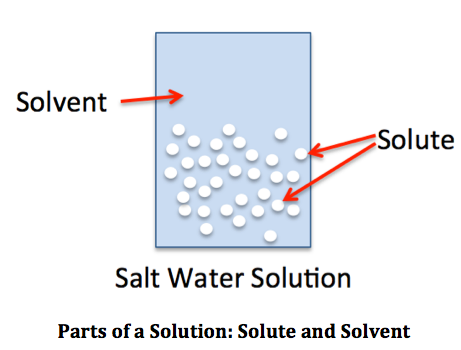
what is solvent?
Generally, the component that is present in the largest quantity is known as a solvent.In fact, a solvent is a substance that dissolves a solute, resulting in a solution.The solvent determines the physical state in which the solution exists. One or more component present in the solution other than the solvent is called solutes.
ABOUT SOLVENT
In chemistry, a common rule for determining if a solvent will dissolve a given solute is "like dissolves like."Solvents made out of polar molecules, for example (water)break down other polar molecules, like (table salt) and nonpolar solvents such as fuel,
disintegrate nonpolar substances like wax. The degree that a solvent dissolves a given solute is known as its solubility. Ethyl alcohol is exceptionally dissolvable in water, for instance, Vinegar is very insoluble in oil, and the two substances will quickly separate into two layers even after being shaken well.
Imagine that a teaspoon of salt is poured in a glass containing water. For this situation, the salt is solute and water is solvent. Investigate the picture underneath.
Water is a solvent for polar molecules. Water is the most common solvent, all the ions and proteins in a cell are dissolved in water within the cell.
SOLVENT CLASSIFICATION
It very well may be characterized into two sorts;
1) Polar
2) non-polar
An uncommon case is mercury, whose alloys are known as amalgams; likewise, other metals solutions exist which are fluid at room temperature Generally, the dielectric constant of the solvent gives an unpleasant proportion of a solvent's extremity. The solid extremity of water is shown by its high dielectric consistent of 88 (at 0 °C).Solvents with a dielectric consistent of under 15 are commonly viewed as nonpolar.
The dielectric consistent estimates the solvent's propensity to somewhat drop the field quality of the electric field of a charged molecule inundated(immersed) in it.
Some common examples of solvent are
NON-POLAR SOLVENTS
1) HEXANE
2) PENTANE
3) BENZENE
4) TOLUENE
5) CHLOROFORM
POLAR SOLVENTS
1)TETRAHYDROFURAN
2)ACETONE
3)ETHANOL
4)WATER
5)FORMIC ACID
the density of solvent
Most organic solvents have a lower density than water, which means they are lighter than and will form a layer on top of the water. Most organic solvents have a lower density than water, which means they are lighter than and will form a layer on top of the water. Significant exceptions are the majority of the halogenated solvents like dichloromethane or chloroform will sink to the base of a container, leaving the water as the top layer.
This is critical to recall when parceling mixtures among solvents and water in a separatory channel during chemical syntheses.
The boiling point of the solvents;
The breaking(boiling) point is a significant property since it decides the speed of (evaporation) dissipation.Restricted amounts of low-limit(boiling point) solvents likediethyl ether, dichloromethane, or CH3)2CO will evaporate in seconds at room temperature,while high-limit solvents like water or dimethyl sulfoxide need higher temperatures,a wind current, or the use of vacuum for quick dissipation.
Low boilers: boiling point below 100 °C.
Medium boilers: between 100 °C and 150 °C.
High boilers: above 150 °C.
POLAR SOLVENTS SUBCLASSIFICATION
1) POLAR PROTIC SOLVENT
2) POLAR APROTIC SOLVENT
Solvents with a dielectric constant more noteworthy than 15 (for example polar or polarizable) Can be additionally isolated into protic and aprotic.
Protic solvents solvate anions (contrarily -ve charged solutes) Strongly by means of hydrogen bonding. Water is a protic dissolvable. Aprotic solvents, for example, acetone or dichloromethane will, in general, have enormous dipole moments and solvate emphatically +ve charged species by means of their negative dipole These polar solvents are fit for shaping(capable of forming) hydrogen bonds with water to break down in water though non-polar solvents are not equipped(not capable of forming) for solid hydrogen bonds.
(Very important note) ;
Polar protic solvents favor SN1 reaction mechanism, whereas the polar aprotic solvents favor SN2 reaction mechanism.
SOLVENT CLASSIFICATION
It very well may be characterized into two sorts;
1) Polar
2) non-polar
An uncommon case is mercury, whose alloys are known as amalgams; likewise, other metals solutions exist which are fluid at room temperature Generally, the dielectric constant of the solvent gives an unpleasant proportion of a solvent's extremity. The solid extremity of water is shown by its high dielectric consistent of 88 (at 0 °C).Solvents with a dielectric consistent of under 15 are commonly viewed as nonpolar.
The dielectric consistent estimates the solvent's propensity to somewhat drop the field quality of the electric field of a charged molecule inundated(immersed) in it.
Some common examples of solvent are
NON-POLAR SOLVENTS
1) HEXANE
2) PENTANE
3) BENZENE
4) TOLUENE
5) CHLOROFORM
POLAR SOLVENTS
1)TETRAHYDROFURAN
2)ACETONE
3)ETHANOL
4)WATER
5)FORMIC ACID
the density of solvent
Most organic solvents have a lower density than water, which means they are lighter than and will form a layer on top of the water. Most organic solvents have a lower density than water, which means they are lighter than and will form a layer on top of the water. Significant exceptions are the majority of the halogenated solvents like dichloromethane or chloroform will sink to the base of a container, leaving the water as the top layer.
This is critical to recall when parceling mixtures among solvents and water in a separatory channel during chemical syntheses.
The boiling point of the solvents;
The breaking(boiling) point is a significant property since it decides the speed of (evaporation) dissipation.Restricted amounts of low-limit(boiling point) solvents likediethyl ether, dichloromethane, or CH3)2CO will evaporate in seconds at room temperature,while high-limit solvents like water or dimethyl sulfoxide need higher temperatures,a wind current, or the use of vacuum for quick dissipation.
Low boilers: boiling point below 100 °C.
Medium boilers: between 100 °C and 150 °C.
High boilers: above 150 °C.
POLAR SOLVENTS SUBCLASSIFICATION
1) POLAR PROTIC SOLVENT
2) POLAR APROTIC SOLVENT
Solvents with a dielectric constant more noteworthy than 15 (for example polar or polarizable) Can be additionally isolated into protic and aprotic.
Protic solvents solvate anions (contrarily -ve charged solutes) Strongly by means of hydrogen bonding. Water is a protic dissolvable. Aprotic solvents, for example, acetone or dichloromethane will, in general, have enormous dipole moments and solvate emphatically +ve charged species by means of their negative dipole These polar solvents are fit for shaping(capable of forming) hydrogen bonds with water to break down in water though non-polar solvents are not equipped(not capable of forming) for solid hydrogen bonds.
(Very important note) ;
Polar protic solvents favor SN1 reaction mechanism, whereas the polar aprotic solvents favor SN2 reaction mechanism.
